
Nobody Invented This Universal Pattern
A physics student on holiday discovered a Nobel laureate’s pattern on a medieval shrine, completed five centuries before said laureate was born. The pattern was never invented.

(Book links below lead to our Library, where they become affiliate links; if you buy through them, we earn a small commission at no extra cost to you, and your purchase supports our work. Thank you.)
Early in my Magnum Opus, when I had just fallen down the Joseph Campbell rabbit hole and his Power of Myth PBS special was still freely available on YouTube, the algorithm did something peculiar. It delivered me a doorway. I was being tracked, profiled, and fed — the whole apparatus I spend essays describing as an aspect of the Wasteland — and on the strength of my Campbell viewing, YouTube served me a six-minute TED talk about floor tiles. I almost skipped it. I am glad I did not because that talk walked me, one curiosity pulling the next, all the way to David Bohm, and Bohm rearranged how I see everything. A data-harvesting machine ironically played psychopomp. Hold that irony; we will come back to it, because it turns out to be my whole point.
The talk was Terry Moore’s, and it tells a true story I will expand upon.
Five Hundred Years Early
In the 1970s the mathematician Roger Penrose — now Sir Roger, and since 2020 a Nobel laureate for showing that black holes are a genuine prediction of Einstein’s relativity — was playing with a humbler problem: tiling. Tiles, the way you would tile a floor, fitted together to cover a surface with no gaps. The ordinary way to do it repeats; lift the bathroom floor, slide it over, and it lands back on itself. Penrose found something stranger. Using only two shapes, he built a pattern that fills the plane forever and never once repeats: slide it any direction, any distance, and it never comes back into register. Mathematicians call that property aperiodicity. It is the same thing pi does, a decimal that runs on without ever falling into a loop. Two shapes. Infinite, unrepeating order. They named it Penrose tiling.
Fast forward to 2007. A young physicist named Peter Lu, then a graduate student at Harvard, is on vacation in Uzbekistan and keeps noticing the dizzying geometric tilework on its old buildings, the star-and-polygon designs that Islamic art calls girih. Something about them would not let him go. Back home, he and the Princeton physicist Paul Steinhardt worked it out and they published their results in Science: the medieval craftsmen had not been improvising with straightedge and compass, as everyone had assumed. By around 1200 they had worked out a set of tiles that let them build these patterns, and by the 15th century, on monuments like the Darb-i Imam shrine in Isfahan, they had produced very nearly perfect Penrose tilings: the aperiodic order, the thing Penrose would “discover” in the 1970s, sitting finished on a wall built in 1453. Five hundred years early. (Moore’s telling places Lu at Princeton and the design on a madrassa; he was at Harvard, and the showpiece is a shrine in Iran. The bones of the story are sound.)
Discover magazine ranked it among the year’s notable discoveries. Sit with how odd that is: they slotted a pattern that already bore a living mathematician’s name, Penrose tiling, onto a list of the year’s new findings, and saw nothing strange in ranking a re-finding of the already-found. The apparatus that anoints discoveries, the journals and year-end lists that certify what counts as real science, is the same commercial machine Rupert Sheldrake has spent a career arraigning, the one men like Robert Maxwell of Pergamon Press built into an empire, selling the safe and the citable back to us. It can price the husk, and it was asleep to the rest. But its ranking is not the interesting part. The interesting part is the question it forces, and Moore asks it directly: what did this culture see in this pattern that made them carve it onto their holiest buildings?
The Pattern Is Life
Here his talk turns from mathematics to anthropology, and this is where it hooked me. Ask what these craftsmen believed, and the answer is that the pattern is a picture of life. Look at it and you see why. It is complicated, the way a life is, and the way Emily Wilson’s Odysseus is. And it is aperiodic in the deepest sense, because every choice, every accident, and every death sends the future down a path it will not retrace. Nothing repeats. Yet, beneath the bewildering surface, there is a single hidden order holding all of it together, one structure out of which the whole endless non-repetition unfolds. It is the same order beneath the chaos I write about in Love Isn’t All You Need. More than anything else I had read or watched, this one small talk is what set that idea in me, and it has run beneath everything I have written since.
The craftsmen knew exactly how to show you this, and their method is itself a teaching. To lay out their tiles they first drew a web of construction lines, the scaffolding, the geometry underneath. Then, in their finished work, they erased it. The order that governs every cut is nowhere visible in the result. Moore’s reveal is simply to put the construction lines back, and there it is: under the chaos of the surface, a calm and total unity that was present the entire time, deliberately hidden so its beauty could stand on its own. Order had to be concealed to do its work. That is not decoration. It is a doctrine, carved into a wall by people who wanted us to dis-cover it.
Egyptians worked in the same fashion. Before an artist painted or carved a wall, they snapped down a grid of red guidelines and fitted every figure to it, holding a canon of proportion the Egyptians bound to maat, their cosmic order, and then the finished relief covered the grid over until it vanished. We know because unfinished tombs still show it: where their work stopped mid-wall, the red scaffolding and the underdrawing stand exposed, the buried geometry every completed surface was built on and then concealed. Moore put the construction lines back; Egypt left a handful of walls where they were never taken away. Their first job was fidelity to canon, and their canon was itself an image of their cosmic order, so the hidden grid was the sacred proportion underneath the sacred picture.
Geometry Is Sacred
None of this was new to the people who built the shrine, because the conviction that geometry is sacred is among the oldest our species has. Those craftsmen worked inside a tradition with a name, Sacred Geometry, the belief that proportion and form are not neutral decoration but the very script in which our cosmos writes its order, so that to draw a true figure is to trace its structure underneath things. Its fountainhead in the West is Pythagoras, who taught that all is number, that reality is built of ratio and harmony, the earliest Western form of the claim my whole essay keeps circling. It did not stop at Greece. What Egypt had bound to maat and Pythagoras to number, Rome bound to proportion. Vitruvius, in his ten books on architecture, established the rule our whole Western tradition would inherit: a building’s measures should answer to the measures of the human body, and the body’s to the cosmos, the correspondence Leonardo would later draw as Vitruvian Man. Their Pantheon makes it concrete, a temple laid out as a single geometric solid, its dome the vault of heaven and its round eye our sun, and its name, fittingly, is “all the gods.” The same conviction runs through the Freemasons, heirs of medieval stonemasons’ lodges, who set geometry at the literal center of their emblem. Most people read the G in their square and compasses as standing for God; in their craft it stands at least as much for Geometry, a sacred science, and that these two now look like a misreading of each other is precisely the amnesia I am describing. The Masonic writer Michael Schiavello unpacks the layered meanings of this one letter better than I can, in his 2016 book Know Thyself: Using the Symbols of Freemasonry to Improve Your Life:
“In the centre of the famous Masonic square and compass is placed the letter ‘G’. Masonic ritual tells us the letter G stands for ‘God’, ‘Geometry’, and the ‘Great Geometrician of the Universe.’ The square and compass are symbolic of you. The compass represents your spiritual/higher-self sitting above the square, which is symbolic of your material self. The placement of the G at the center of this symbol represents the divine spark at your centre.
It is no coincidence that G is the seventh letter of the English alphabet; the number seven has long been considered a sacred number by Freemasons, certain religions and ancient mystery schools.”
You can stand inside proof: masons who raised Chartres encoded the same sacred geometry into a Christian cathedral that Isfahan craftsmen carved into their Islamic shrine, the labyrinth and the rose windows and the proportions all saying it, two faiths and two continents reaching the same buried order in stone. The builder and teacher Randall Carlson, himself a Mason, has spent his career reading architecture as exactly what Moore says it is, a book written in stone, for anyone who troubles to learn its alphabet.
An Order With Many Names
The conviction that a single hidden unity underlies our visible world is not a quirk of one Persian workshop. Moore runs the same thread through Egypt, Greece, Mesoamerica, Australia, and everywhere else, and he is right that it keeps surfacing, because it is a perennial intuition, an idea we cannot stop re-dis-covering. We have given it 10,000 names. A modern Westerner says God. Plotinus called it the One. Spinoza called it the single substance, deus sive natura, the one thing of which everything else is only a mode. Philosopher F. S. C. Northrop, reaching for a 20th century vocabulary, called it the undifferentiated aesthetic continuum. (Moore attributes that phrase to Whitehead; it is Northrop’s.)
And then there is the name I prefer, because I came to all of this through a physicist. David Bohm, who worked alongside Einstein at Princeton and was one of the serious minds of 20th century quantum theory, called it the implicate order, and gave it a book, Wholeness and the Implicate Order. Bohm’s claim is that the world we see, the explicate order of separate things in separate places, is the unfolding of a deeper order in which everything is enfolded into everything, a seamless whole that is logically and physically prior to its parts. Construction lines, in other words. Tiles are the explicate order. The invisible geometry that governs them is the implicate one. A medieval craftsman and a quantum physicist drew the same diagram and meant the same thing by it. So let me plainly posit: these are visual manifestations of the Perennial Philosophy, the one truth the TED talk keeps circling without ever naming.
Nobody Invented This
Which brings my title around. Set the evidence beside each other: Penrose finds the pattern in the 1970s; Persian craftsmen have it in 1453; neither got it from the other. The natural word is coincidence, or convergence. Consider, for a moment, how strange it is that a form can appear, complete, in two minds with five centuries and a continent between them and no known connections. How does a pattern do that?
Notice first that nobody in this story sounds like an inventor; they sound like finders. Penrose himself is the tell: he is an unembarrassed Platonist who holds that mathematical truth is not made up but discovered, that theorems are out there in a real Platonic world and a mathematician is an explorer who stumbles onto what was already the case. On that view he did not invent his tiling any more than Columbus invented America. He found a structure that existed before he was born, which is exactly what the craftsmen had found. And notice the verb itself. To discover is to dis-cover, to take the covering off something that was already there, the exact opposite of making it up. The craftsmen had run the opposite motion, drawing construction lines and then hiding them, erasing them from the finished wall; to find the pattern again is only to un-cover what they concealed. You cannot dis-cover what was never there to begin with.
And this structure was not waiting in some abstract heaven. It was sitting in matter the whole time. In the years after Penrose, the materials scientist Dan Shechtman put a strange aluminum-manganese alloy, quenched so fast that it had frozen mid-transformation, under an electron microscope and saw its electrons scatter into a ring of ten bright points, a tenfold symmetry that every rule of crystallography forbade. He scrawled a row of question marks in his notebook and said to himself, in Hebrew, that there could be no such creature. He was looking at a quasicrystal, a three-dimensional cousin of Penrose’s tiles. He was mocked for it. Linus Pauling, twice a Nobel laureate, told rooms that there was no such thing as quasicrystals, only “quasi-scientists.” Shechtman held his ground, and in 2011 the impossible crystal won him the Nobel Prize in Chemistry. There is an old line, usually pinned on Schopenhauer though no one has found it in his actual writing, that all truth passes through three stages: first it is ridiculed, then it is violently opposed, then it is accepted as self-evident. Pauling’s sneer was stage one; the medal, stage three. The pattern had been in the structure of matter all along. Reality was holding out the entire time; what had to change was not the world but our willingness to see what was in it.
The Memory of Forms
So the form was real and there to be found. That still does not explain the leap, how it surfaced in 15th century Isfahan and 20th century Oxford with nothing material connecting them. For that I must reach for the most heretical name in this essay, and one of the most load-bearing in my books: Rupert Sheldrake and his hypothesis of morphic resonance.
Sheldrake’s proposal, stripped down, is that nature has memory. Our so-called laws of nature behave more like habits: once a form or a pattern or a behavior comes into being, it becomes easier for it to come into being again, anywhere, through a form of resonance across time that requires no physical channel. Forms wear grooves. The 100th instance arrives more readily than the first. If he is even partly right, then the question of how the same pattern appeared twice answers itself. Craftsmen did not invent it, and Penrose did not invent it; they both tuned in to a form that already had a groove worn into our morphic field, a shape the cosmos had, in some real sense, already learned.
This is not as lonely a claim as the establishment makes it sound. Bohm and Sheldrake actually sat down together, more than once, and argued in public about precisely this, over whether morphic fields and the implicate order were two descriptions of one thing. Bohm’s read was that resonance could be understood as a dynamics within the implicate order: our enfolded whole is the medium, and resonance is the weather moving through it. The biologist and the physicist met in the middle, and their middle was the same hidden unity the craftsman had carved in stone. Later in his life Sheldrake widened that table further, in a long-running set of recorded Trialogues with the dynamical-systems mathematician Ralph Abraham and the ethnobotanist Terence McKenna, the same questions worked from three directions at once. The best of those sessions were gathered into two books, Chaos, Creativity, and Cosmic Consciousness and The Evolutionary Mind.
There is one apparent snag, and it is actually the prize. Morphic resonance is about recurrence, about forms repeating. Penrose tiling never repeats; that is its entire nature. A contradiction? No: a revelation. The tiling is novel at every single point and one unbroken order underneath, both at once, which is precisely life as the craftsmen read it. Never the same moment twice, and yet the same shapes recurring, the same archetypes surfacing in culture after culture, the same hero’s journey told 10,000 ways. Aperiodic and resonant. The pattern reconciles two things our modern world swears cannot both be true: that everything is genuinely new and that nothing is. It is the picture of a reality that never repeats and never stops rhyming. And here I will be bold, because the math earns it. A paradox is only a contradiction seen from too few dimensions; step up one, and opposites that seemed to flee each other forever turn out to be a single thing. This is not a metaphor I am laying over the tiles. It is how the tiles are made. A Penrose tiling is the shadow of a perfectly periodic crystal that lives in a higher-dimensional space, sliced and projected down into ours, where it lands as order that never repeats; quasicrystals are cast the same way, flawless higher lattices casting their shadows into three dimensions. This snag dissolves exactly where I argue every paradox does: go up a dimension, and never-repeats and one-unbroken-order stop being two opposite facts and become one thing, observed from the level that is capable of gently holding them both. It is the same move I make with the word eternity in Calibrating the Lens: a line you could walk forever becomes, seen from one dimension up, a circle you were standing inside the whole time.
A Book for Burning
You may have noticed a refrain. The man who discovered the impossible crystal was called a quasi-scientist. The man who proposed that nature remembers got something worse. In 1981 the editor of Nature, John Maddox, ran an editorial over Sheldrake’s first book, A New Science of Life, under the headline “A Book for Burning?” and called it “the best candidate for burning there has been for many years.” Decades later, when Sheldrake gave a quiet, careful talk questioning dogmas of materialism, TED pulled it from its main channel, and Sheldrake was not even the only casualty that day: TED also purged Graham Hancock’s talk, “The War on Consciousness,” from the very same event. This reception is as consistent as the pattern on the wall.
It is worth being precise about what is doing the rejecting, because it is not science and it is not evidence. It is a habit of mind. The psychiatrist Iain McGilchrist named the two ways we attend to the world: the Master and the Emissary, a pair I lay out in my Wasteland essay. The short of it: the Emissary is the part of us that measures and dissects and pins each thing to a label, a magnificent servant our civilization has crowned as king, and it cannot abide a hidden unity, because a hidden unity is the one thing it has no instrument for. It can measure the tiles. It cannot see the construction lines. So when someone points at them, it reaches not for the microscope but for the match. The Emissary does not argue with order. It tries to burn records of it, the oldest tool it has; the Library of Alexandria is its monument. But a match is the wrong tool for a pattern, because the pattern was never in the book: burn every copy and a Penrose re-finds it, raze the library and the order it held is still standing in the field to be dis-covered again. You can burn a map, never the territory. Remember Moore’s closing line, that architecture is a book written in stone. The high priest of Nature wanted to burn the book that explained how stone remembers. What the match never learns is that it is the wrong tool. There is a name for what censorship does in our networked age, the Streisand effect: burning becomes an advertisement, the ban a recommendation. Maddox’s headline helped make Sheldrake’s book notorious, and the talk TED tried to bury became a talk people sought out, carried, of all couriers, by the very algorithm an old guard never thought to fear. I can vouch for it myself: that buried talk is exactly how Sheldrake first reached me, via After Skool, then his books after that, because I went looking only once I heard it had been silenced. The Streisand effect is not a theory; it is a cousin of morphic resonance.
The Man Who Keeps Pointing
Come back to Penrose, because he is the strangest witness of all, and perhaps the most important. Here is a man at the center of hard physics, decorated to the hilt, who keeps pointing past the mechanism at something the mechanism cannot contain. He pointed at it with the tiles: order beneath apparent randomness. He points at it with his Platonism: truth dis-covered, not built. And late in life, protected by exactly the laurels that would have ended a younger man’s career, he points at it most boldly of all, in his work on consciousness. His timing is not incidental. Study of consciousness is not a young person’s game, for reasons both prudent and deep. To take the hard problem seriously, to suggest the mind is anything other than computation, is reputational poison for a scientist still building a career, so the work tends to wait for tenure and laurels and freedom of having nothing left to prove; and it asks for a lifetime’s synthesis across physics, mathematics, neuroscience, and philosophy that no young specialist has yet had the years to gather. Penrose has that synthesis and has become one of the most serious living thinkers on this hard problem.
Penrose’s claim, developed in The Emperor’s New Mind and worked out with the anesthesiologist Stuart Hameroff as a theory they call orchestrated objective reduction, is that your mind is not a computer. Drawing on Gödel’s incompleteness theorems, he argues that human understanding does something no algorithm can do, that consciousness is non-computable, that there is a Master in us not reducible to the Emissary’s machinery. You do not have to accept microtubules to feel the force of this move. The man who gave us visible proof that order hides beneath chaos is spending his last act insisting that the same is true of your mind, that beneath computation there is something that was never computed and never invented, only discovered, looking out through your eyes right now.
I part ways with him on one thing, and it is the emphasis on microtubules. This is the aspect of his theory that will send brilliant people down material rabbit holes for decades, hunting in our wet machinery for the seat of a thing that does not live there, trying to dis-cover, in matter, that which is not. It is the same verb from before, run off a cliff: you can un-cover only what is already there; the broadcast was never inside the radio. Much of their work is in facts about how anesthesia switches our lights out, gases that abolish consciousness acting on our microtubules, which is how Hameroff, an anesthesiologist, came to their theory at all; but turning the receiver off tells you nothing about where the signal was sent from. There is an older counter-tradition that saw this coming. Henri Bergson and William James suspected the brain might be less the generator of mind than a filter for it; Aldous Huxley, borrowing them in The Doors of Perception, called it a reducing valve, throttling a vast awareness down to the trickle that survival needs. Sheldrake stands in that same line, and so does McKenna: your brain as a receiver, not as a sender. It is the whole spine of this essay wearing a neurologist’s coat. We do not manufacture the signal. We tune in. My wager, not proof, is that the microtubule hunt comes back empty, and that the non-computable Master will never be found by attempting to dis-assemble her antenna.
It matters that Penrose can say this because no one can fire him. Elsewhere I have called that condition a disease, the auteur with no one left to tell him no. Here it is the cure. Status, for once, spent well: earned freedom to chase heresy that happens to be true.
The Name
Here is where I diverge from the TED talk we started with, because that talk was built for a secular audience and I do not write as a secular author. Moore walks you to the edge of the implicate order and stops, content to leave it a structure, a diagram, an impersonal order you may admire from a safe distance. That distance is the Emissary’s, and it is the exact threshold I mean to cross. Traditions that mapped this country longest did not call it a structure. They gave it a Name, and that difference is the whole of it: you can diagram a structure, but a Name is something you can only stand before.
The Name at the center of the West is the one it will not say. When Moses asks who is sending him, the voice answers ehyeh asher ehyeh, I am that I am, or as fairly, I will be what I will be, and then gives four letters, YHVH, built from the Hebrew verb to be. Read it slowly; it is the move this essay has been making all along. It is being itself, named in a tense that folds was and is and will-be into one, which is the word eternity seen from a dimension up and spoken as God. It is unpronounceable on purpose, because to say it would be to make it a thing among things, which is the very reason the Master is non-computable: we may point at it, we cannot trap it in symbols. And the oldest readings hear inside those four letters a marriage, masculine and feminine, upper and lower, joined in the Name itself, so that union of opposites is not something this God does but something this God is. Those same four letters are also set against the four elements, fire and water and air and earth, folding our whole material cosmos into a single unsayable Name. Kabbalists drew it as a tree with two warring pillars, Mercy against Severity, reconciled down the middle column, opposites not cancelled but wed. Yogis mapped it up the human spine: the lunar ida and solar pingala, the feminine and masculine currents, winding around the central sushumna, reconciled only in the channel between them. The Buddha drew the same center and named it his Middle Way, the path that runs between extremes instead of choosing one. What Nicholas of Cusa called the coincidence of opposites, the place where a line becomes a circle, mystics had already drawn as the very shape of God.
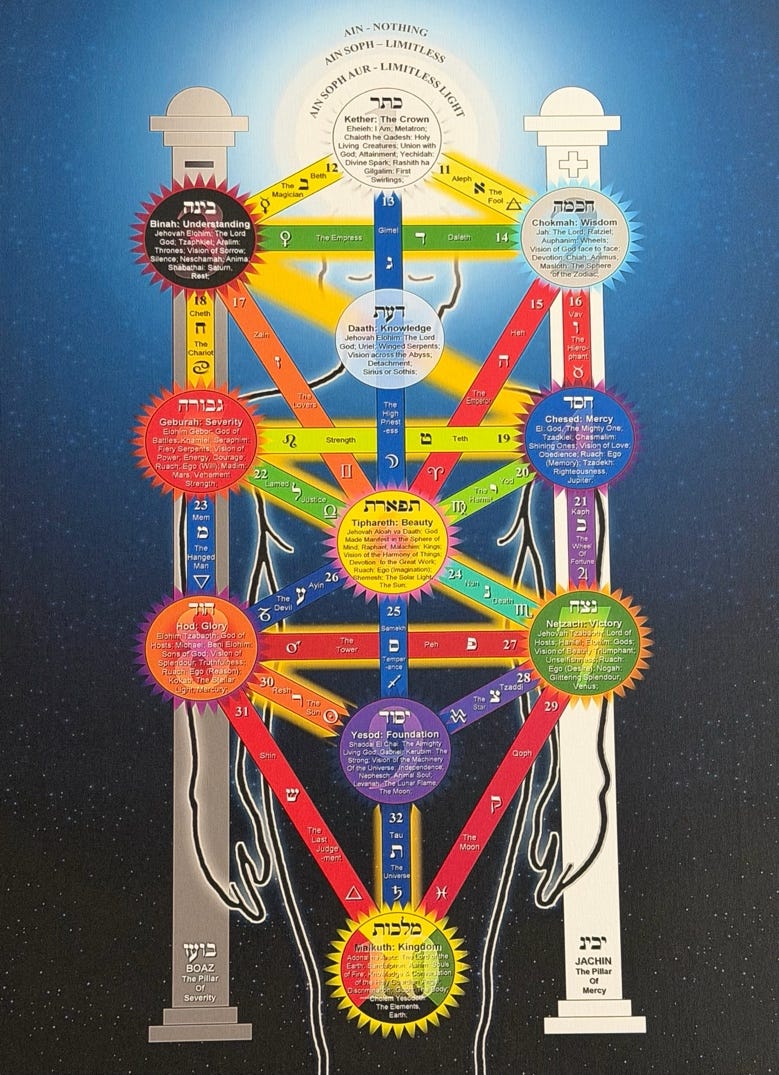
This is the power we have been circling without naming, and it has a plain old description: to bridge the pair of opposites. Joseph Campbell gave life to it, the discovery that the divine is precisely what stands beyond every opposed pair, and that a hero’s task is to find the seam where they meet. You have been doing it in miniature this entire time, dissolving one contradiction after another by stepping up a level: aperiodic and resonant, novel and recurring, Master and Emissary, hidden and revealed. The Name is what you reach when they all dissolve at once, the gestalt I describe in Calibrating the Lens, the whole that appears only when you stop staring at the parts. Nor is this a Western parochialism. The Tao holds yin and yang not as a truce but as one figure, and the symbol says what most miss: each half carries a seed of its other, the dark eye set in light and the light eye in dark, so that neither half is ever pure and each is already becoming its opposite, and the circle drawn around them is the whole that held the pair as one all along. Out of that undivided source the Tao gives birth to what the old texts call 10,000 things, our whole teeming world, each of them the One in disguise. The Vedic world even hands you a sound for it: AUM, the Name the One is called by, its three tones folding waking, dream, and deep sleep into the silence that follows. Vedanta approaches its one reality by neti neti, not this, not that, because the One is past every pair; and Indra’s net hangs our cosmos as endless jewels each reflecting all others, the implicate order and morphic resonance in one ancient image. Our secular implicate order is only the newest name on a very long list, and that list wears 10,000 faces because the thing it names is the One that wears them all. Moore’s talk ends at a structure. I end pointing at a Name, because order was never impersonal. It is the face you have forgotten you were searching for.
So here is the whole of it, smaller and larger than it seemed. There is no inventor. Not of tiling, not of the crystal, not of your mind. There is an order, hidden and prior and patient, the same one a Persian workshop patiently carved and a quantum physicist diagrammed and a heretic biologist said our universe remembers, and we do not build it. We tune in. The most we ever do is get quiet enough, and curious enough, to catch what is already there.
This is not defeat. It is the best news there is, and it is the opposite of the lonely modern story in which meaning is something we manufacture and then defend against the void. This pattern is not waiting on us to invent it. It is waiting on each of us to dis-cover it. Which is the whole wager of the book I am writing: that the door is not built but found, and that the key that opens it is the oldest and least technological thing you already have.
In the ninth chapter, I follow this idea all the way into your body: your heart as a rhythm that ripples out through the whole of you, resonating, not so unlike a crystal, so that the resonance we have been chasing across continents and centuries is also the organ beating in your chest as you read this. Stephen Harrod Buhner spent a whole book on exactly that, The Secret Teachings of Plants, reading your heart as an organ of perception and resonance rather than only a pump. You were never outside the pattern, looking for a way in. You are it.
These ideas run underneath everything I am building. The book is Love Isn’t All You Need: A Manifesto for Curiosity, the first volume of The Manifesto Series, out later this year; the deeper architecture, the whole library that maps this territory corner by corner, has a name, The Athanor, and it is being built now. Leave your email at loveisntallyouneed.com/notify and I will tell you the moment either one opens.