
A Complicated Man
Nolan’s Odyssey is not about Homer. It’s about a culture that can no longer tell its merchandise from its myths.

(The book links below lead to our Library, where they become affiliate links; if you buy through them, we earn a small commission at no extra cost to you, and the purchase supports the work. Thank you.)
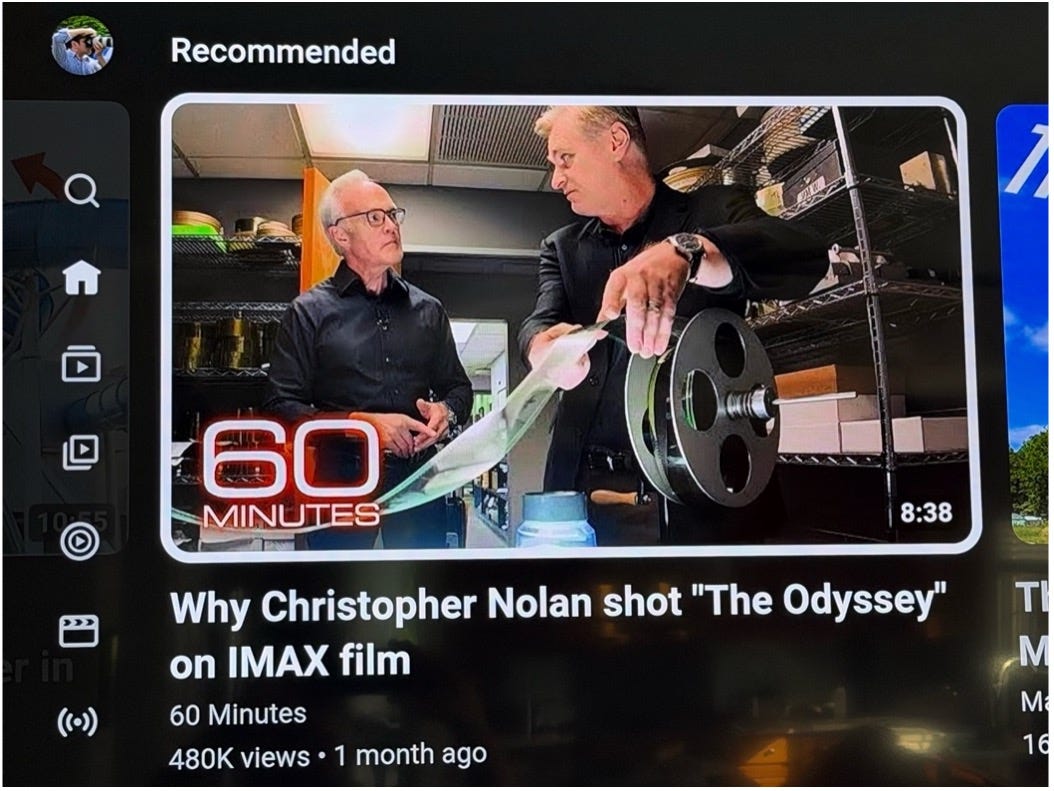
Christopher Nolan’s The Odyssey arrives on July 17 as one of the most anticipated films of the year, and it arrives under three clouds: the translation it leans on, the cast it assembled, and the format it was shot in. And the audience has already voted. YouTube hides dislikes, and third-party counters agree: the final trailer is the most disliked of Nolan’s career, with more dislikes than every trailer he has released in fifteen years combined. By those counts it has passed 700,000 dislikes against roughly 70,000 likes, a ratio near 10:1 and still climbing, with 300,000 added in a single 72-hour stretch. A career of 98% approval, collapsing in one preview to the second-most-disliked trailer in the history of YouTube, behind only Disney’s infamous Snow White — and all of it before a single frame of the finished film has been screened. The internet is treating these as three separate complaints. They are not. They are one complaint wearing three coats, and to see the body beneath them you need a frame.
Emissary on the Throne
All frames are wrong. Some are more useful than others. The Wasteland, the essay the rest of my writing stands on, reads our condition through many lenses; the one this film needs is Iain McGilchrist’s Master and his Emissary. The two hemispheres are two ways of attending. The Master takes in the whole: context, relationship, meaning. The Emissary works the part: it grasps, abstracts, counts, and builds, dazzling within its beam and blind to everything past it. The Master understands. The Emissary uses. And the Emissary has taken the throne.
Hold that frame up to The Odyssey, and the three clouds resolve into one. Every complaint about this film is a complaint about the Emissary handling something that belongs to the Master.
A Complicated Man
Start with the translation, because the editing of a myth begins long before a frame is even shot. Nolan has said he leaned on Emily Wilson’s widely acclaimed 2017 translation, the first Odyssey rendered into English by a woman. In Empire he singled out her opening line: “I think it’s the Emily Wilson translation that begins, ‘Tell me about a complicated man.’ The genius of the character, the cleverness, the inventiveness of him, that was a huge part of what interested me.”
It is worth noticing how that praise tends to arrive. What leads, almost every time, is that Wilson is the first woman to render the Odyssey into English — the milestone before the lines. The distinction is real, and her translation is genuinely good. But a culture that applauds the credential first and the craft second is the Emissary applauding: it loves the label, because a label can be counted, where merit cannot. Hold the thought. The same reflex is about to choose the cast.
The word under “complicated” is polytropos — literally “many-turned,” or “of many ways.” It is the first thing Homer tells us about Odysseus, and it carries the whole man: the shapeshifter, the trickster, the navigator of a thousand wiles, turned by the gods and turning everyone around him. Translators have circled it for centuries. Fitzgerald gave “skilled in all ways of contending,” Fagles “the man of twists and turns,” Lattimore “of many ways.” Wilson gave “complicated,” and it is a genuinely fine choice — plain, modern, instantly human. It is also the Emissary’s word. “Complicated” is what we call a man on a dating profile. It trades the many-turned shapeshifter for a therapeutic adjective, the archetype for the relatable. And the mask has a proper name. Odysseus is the Trickster — the seat of Hermes and Loki and every survivor who gets through by cunning and disguise rather than by strength — the one figure the passage brushes past, listed among his masks but never lifted up as the face beneath them. That is what polytropos carries, and it is precisely what “complicated” cannot hold. Something true is gained. Something older is quietly cheapened, if not completely lost.
There is a deeper hazard in leaning on so new a rendering. A myth that has lasted three thousand years has had its translations vetted by time: generation after generation has weighed Chapman and Pope and Fagles against the original and against their own lives, and what endured, endured for reasons. A 2017 translation, however fine, has not yet been tested that way. To build a definitive film on the most recent version available is to trust the rendering that has had the least time to be found wrong, which is, again, the Emissary’s instinct: the current and the accessible over the slow authority of what has lasted.
This is not a small thing, and Christian Scripture is where you can watch it happen at scale. Around the third century before Christ, in Alexandria, Greek-speaking Jews began rendering their Hebrew scriptures into Greek — the Septuagint — for a diaspora that no longer read Hebrew. When the translators reached Isaiah, a century or so later, they met the Hebrew word almah: a young woman of marriageable age, a maiden. The precise Hebrew for virgin was a different word, betulah. They chose the Greek parthenos, which leans hard toward virgin. In Isaiah’s own setting the choice was almost certainly innocent. The woman in the passage is a figure of the prophet’s own day, and her child a sign to a king who would be dead 700 years before Jesus was born. A young woman, in that world, was presumed chaste, so parthenos was not a lie. It was a narrowing. And it landed in fertile ground. Alexandria was the most syncretic city on earth — Greek shrines, Egyptian temples, and Jewish synagogues trading gods in the same streets — and the surrounding myths were thick with divine begettings and miraculous births. “A virgin shall conceive” had soil to grow in long before anyone needed it to. What later happened to that city and its library, and why a civilization burns its own crossroads, is a story for a future book.
The narrowing did its work three centuries on. Around the year 80, the author we call Matthew set out to write the life of Jesus in Greek, and he built his entire gospel on one architectural move: this happened to fulfill what was spoken by the prophet. Reaching for Isaiah, he did not reach for the Hebrew almah. He reached for the Greek parthenos already waiting in the Septuagint, and quoted it — “the virgin shall conceive.” A whole doctrine of virgin birth grew in the gap between a maiden and a virgin, a gap that existed only in translation. Whether the first translators intended it, no one can say. Matthew’s use of it was no accident. That is the difference between the unconscious face of translation bias and the conscious one.
For the conscious face in its purest form, walk forward to 1909. A former lawyer and Confederate soldier named Cyrus Scofield published, through Oxford University Press, a Bible with his own footnotes running along the bottom of nearly every page. The notes systematized dispensationalism — the prophetic schema the British preacher John Nelson Darby had devised, with its rapture, its rigid wall between Church and Israel, and its countdown to a premillennial end — and presented it not as one man’s interpretation but as the plain sense of the text. Printed beneath holy writ and carrying the imprimatur of Oxford, the commentary became indistinguishable from the commented. Two million copies later, whole generations of American evangelicals can no longer tell where Scripture ends and Scofield begins. He never translated a word. He simply stood close enough to the text that his agenda was mistaken for it.
A maiden becomes a virgin; a footnote becomes Scripture; polytropos becomes complicated. The receiving culture always remakes the text in its own image, and it rarely notices it is doing it.
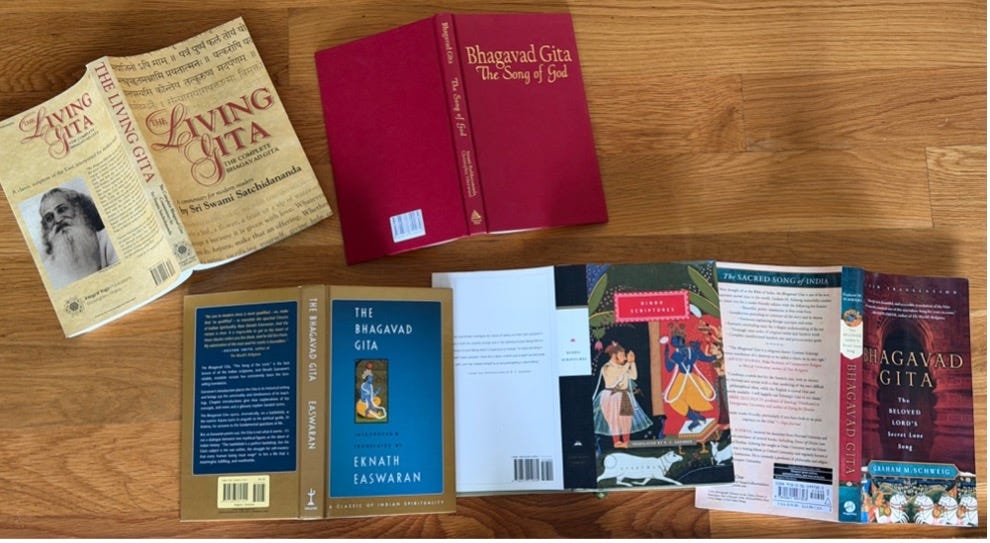
Which raises the question of why you would build exclusively on one translation at all. Personally, I keep several translations of the Bhagavad Gita on my bookshelf, and I have read them all — not out of scholarship, but because the truth of a living scripture does not sit inside any single rendering. It lives in the space between them. You triangulate it, the way you fix a star by sighting from more than one place. And reading across versions does something else: the versions with an agenda begin to show. Held against the others, slants become visible, and in time its authority may wax and wane. The reverent reader keeps the biased translation as one voice among many. He never mistakes it for the voice.
Take the most famous line of the Gita in the Western mind: the verse Robert Oppenheimer used when the first atomic fire lit the desert, chapter 11, verse 32. Oppenheimer said it himself, on camera, in 1965; Nolan put the moment on screen. In the Sanskrit the pivotal word is kāla, which means Time as fully as it means Death. Here is the version the West knows, and then what four careful translators actually wrote.
Oppenheimer (and Nolan’s film): “Now I am become Death, the destroyer of worlds.”
Zaehner: “Time, am I, wrecker of the world’s destruction, Matured, -- [grimly] resolved (pravrtta) here to swallow up the worlds. Do what thou wilt, all these warriors shall cease to be, Drawn up [there] in their opposing ranks.” (pg. 373)
Schweig: “Time I am, acting to destroy the worlds, advancing forward To completely annihilate the worlds here, ever turning forward. Even without you [acting], they shall all cease to be – Those who are warriors arrayed on the opposing side.” (pg 160)
Easwaran: “I am time, the destroyer of all; I have come to consume the world. Even without your participation, all the warriors gathered here will die” (pg. 198)
Prabhavananda & Isherwood: “I am come as Time, the waster of the peoples, Ready for that hour that ripens their ruin. All these hosts must die; strike, stay your hand – no matter.”
Read them together and notice what is missing. Not one of these translators chose Death. They chose Time, every one of them. And the outlier was Oppenheimer’s own. He read the Sanskrit — he studied it at Berkeley under the scholar Arthur Ryder — and when he reached for the verse, he reached past Time for the more thunderous word. One man’s rendering of one word, spoken once into a camera, overwrote the scripture for an entire civilization.
Nolan repeated it, and here the Wilson problem shows its second face. A director filming history owes fidelity to his subject, and Oppenheimer said what he said; no one faults the quotation. But a storyteller is not a stenographer. He chooses what to amplify, and Nolan carried the outlier to millions without a whisper that the careful hands all kept saying Time. Imagine the other film for a moment. The fire climbs, and Cillian Murphy says: “Now I am become Time, the destroyer of worlds.” The purists howl that the line is misquoted, the historians reach for the 1965 tape, the philologists answer with the Sanskrit, and for one news cycle the whole culture is arguing about what a scripture actually says. That is the good kind of controversy, the kind that corrects instead of corrodes: an old wrong against the Gita begins to unwind, and millions learn that the famous line points at a word its own speaker chose to darken. One word would have done it, and few directors alive had more standing to spend on the gamble. Nolan chose the thunder, hid behind the fact that history said it first, and called the hiding fidelity. It is the same reflex that reached for Wilson, and the same one that filled the cast: take the rendering nearest to hand, the famous one, the one the audience already knows, and let fame stand in for authority. A translation chosen for its moment, a line chosen for its thunder, a cast chosen for its billing: the same hand grasping three times, and never once reaching for a Greek. The Emissary always wants the one line. The Master keeps the whole complicated field.
And there is a fifth book on my bookshelf that is not really a translation at all. In Satchidananda’s The Living Gita the verse comes wrapped in commentary — he, too, renders kāla as Time, then barely lingers there, because for him the line is not even about Time or Death. It is about something much bigger: the outcome already rests in a Higher Will, and your only task is to do your part without claiming the result, the way the temple-keeper blows his conch at dawn and never imagines he is the one raising the sun. That is the context no single rendering can carry: the verse is a teaching on acting and letting go, alive only inside a tradition that never stops interpreting it, teacher to student, generation to generation. Ground a myth in one translation and you keep the thunder while losing the instruction.
So the fact that you can base an entire film on a single translation is already the tell, and it fits a habit Nolan has made famous. He grounds his fictions in literal, technical correctness: the black hole in Interstellar was computed with the physicist Kip Thorne until it was accurate enough to publish in a peer-reviewed journal, and Thorne wrote a whole book on the science. He does it even where the science is barely science. Tenet ran on a “time inversion” so tangled that audiences needed hours of YouTube explainers merely to understand the plot, and the mechanism under it — the Wheeler–Feynman conceit that a positron is only an electron traveling backward in time — is a discarded thought experiment from 1940, not settled physics, one Nolan and Thorne themselves declined to defend as accurate. The rigor is real; what it grounds is often a rumor of science, filmed as though it were law. For science fiction that instinct is a virtue, because physics is the Emissary’s home turf, where “correct” is the entire game. But a myth cannot be grounded. It is true the way deep things are true, not the way a black hole is accurate, and it lives in the symbolic register that belongs to the Master. You can ground a black hole. You cannot ground a god. To pin the Odyssey to one correct-sounding translation is to do to Homer what he did to that black hole: ground the meaning, ground the image, until the symbol can no longer breathe.
Ask the Machine
There is a way to watch this reflex run in its purest form, stripped of every human excuse. Ask any GenAI for the ISBN of a good translation of the Odyssey. You will get Wilson. Not because the machine has set her beside Fagles and Fitzgerald and Lattimore and judged; it has judged nothing, because it has read nothing. You will get Wilson because hers is the newest, the most indexed, the most written-about, the name that sits densest in the ocean of text the machine was trained on. It returns the rendering with the most citations stacked behind it, and mistakes the size of the stack for the merit of the book.
Then ask it to explain itself, and it will tell you, without a flicker of embarrassment, exactly what it did. It chose the most recent translation. It chose the most acclaimed, the most discussed, the one most often recommended. Listen to the reasons and notice that every one of them is a count. Recency, volume, frequency: the machine selects by what can be tallied, because tallying is the whole of what it is. Not one of its reasons is this is the rendering that has survived being weighed against generation after generation of lives. It has no access to that. Endurance is not a quantity a machine can see, and what it cannot count, it cannot value.
This is the Emissary at last with no Master behind it. Recall the two ways of attending: the right hemisphere holds the whole, the context, the living thing in its world; the left grasps, abstracts, counts, manipulates its representations, and is dazzlingly good at it and blind to everything outside its beam. An LLM is that left hemisphere cast into a tool and handed the keys: pure technique, pure retrieval, no context it did not ingest, no meaning it can weigh, no field it can hold. It cannot triangulate the truth that lives in the space between translations, the way you fix a star by sighting from more than one place, because for the machine there is no space between; there is only the surface, and it hands you the densest point on that surface and calls it the answer. Ask it for the whole complicated field and it returns the one line, every time, by construction. The Emissary always wanted the one line. Here is a mind that can want nothing else.
And it does not merely share our bias; it launders it. Trained on a civilization that already applauds the credential before the craft and the milestone before the line, it distills that reflex, reproduces it at scale and at speed, and hands it back wearing the one costume the reflex never had before: the authority of the neutral machine. When a person prefers the current and the accessible, another person can argue with him. When the machine does it, the preference arrives dressed as arithmetic, as consensus, as simply what the answer is. We become three centuries of readers who could no longer tell where Scripture ended and the footnote began, except the footnote now writes itself and signs no name. The receiving culture has always remade the text in its own image. We have just built a mirror that does it instantly, invisibly, and at the scale of every question we are learning to stop asking ourselves.
We Did Not Vanish
Now we consider the casting, which I have written about before in the context of another myth, and will only deepen here. Nolan filled the Greek epic with Matt Damon, Anne Hathaway, Tom Holland, Zendaya, Charlize Theron, Robert Pattinson, Elliot Page as Achilles, and the rapper Travis Scott. Not one Greek among the leads. The Greek press answered with three words: “We did not vanish.”
When I wrote about the live-action Masters of the Universe, I drew a line I still believe: a universal archetype cannot be race-swapped, because it was never raced, while a historically rooted myth can be culturally erased, because it belongs to someone. He-Man is the first kind, invented and weightless and open to anyone. The Odyssey is the second. It is the founding poem of a specific, living people, three thousand years of continuous identity bound to a language and a place. To stage it with no Greeks is not reimagining an archetype; it is erasing a culture from the story it gave the world.
And not only that culture. The Odyssey is the taproot of the entire Western imagination, the first long story the West tells about cunning, homecoming, fidelity, and the passage of a self through a hostile world. For centuries it was the common inheritance every educated person walked through; we used to have to read it in school. We mostly no longer do. Reading for pleasure among the young has been falling for years, and where the poem was still taught, activists have begun removing it outright: a Massachusetts teacher announced in 2020 that she was “very proud to say we got the Odyssey removed from the curriculum.” The West is severing itself from its own headwater at both ends, a generation that does not read it and a movement to unteach it. Nolan only finishes, on the screen, an erasure the classroom had already begun.
There is a stranger reason the Odyssey matters this much, and it comes from one of the twentieth century’s boldest and most disputed ideas. In 1976 the psychologist Julian Jaynes argued that self-consciousness is only about three thousand years old, that earlier humans had a “bicameral” mind, one chamber issuing commands the other obeyed as the voices of gods, with no inner “I” at the center. His prime evidence was Homer. In the Iliad, he observed, no one truly deliberates; the gods speak and men act, moved from outside. By the Odyssey, something new has woken: scheming, second-guessing, an interior self with a hidden inside. On that reading the Odyssey is not merely the founding poem of the Western canon; it is the birth certificate of the Western mind, and the reason “complicated” brushes a truth it cannot hold, because Odysseus is complicated precisely as the first man with an inside to be complicated in. The theory is contested and worth holding lightly. What is not in dispute is the irony: the director best placed to know all this is Christopher Nolan, whose own brother, Jonathan, built Westworld on Jaynes — “We talked about the Julian Jaynes book,” he has said, “which we thought was a very interesting place to start in terms of understanding the hosts’ cognition” — its machines waking from their makers’ voices into selfhood, its finale titled “The Bicameral Mind.” The idea is practically a family heirloom. He made the Emissary’s Odyssey anyway.
Lupita Nyong’o, cast as both Helen and Clytemnestra, waved the objection away: “This is a mythological story.” I want to be careful here, because the sharpest point is not about her, and it is certainly not about her race. It is about a principle she herself once stated better than her critics could. In Black Panther she spoke with real conviction about African people being “in charge of their own destiny,” about cultural specificity over monolith, about the right of a people to re-present themselves. That is the exact argument the Greeks are making now. She made the case for cultural authenticity when it was her own heritage on the screen, and dismissed it as “just mythology” when she was the one displacing someone else’s. Her principle was right the first time. It does not stop being right when it becomes inconvenient. There is even a word for what is happening, and it comes from the same vocabulary. When a dominant culture takes a smaller or older one’s sacred material and refits it in its own image, that discourse calls it cultural appropriation, and at this scale, cultural imperialism. Applied honestly — the only way a principle is worth anything — the phrase does not even flinch. The empire here is Hollywood. The appropriated culture is Greece. The artifact is its founding poem.
Nolan himself has now handed the prosecution its cleanest evidence. Pressed on the revolt, he called it irrelevant — the conversations that happen before anyone has seen the film, he told the Telegraph, are “always irrelevant, because no one having them knows what the film actually is yet” — and then, to account for his calm, he reached for the one comparison that gives the whole game away. He had learned to shrug off this kind of noise, he said, because “I spent ten years dealing with Batman”: when he took up Batman Begins, the character already arrived freighted with decades of “thoughts about what he represents,” and “you can’t worry about any of that at all.” Sit with what that sentence equates. On the one side, a comic-book property owned by a corporation and quarreled over by fans. On the other, the founding poem of a living society and the taproot of the Western mind, defended by the nation that has been its steward for three thousand years. Nolan files them in the same drawer. He cannot tell the difference between fans who dislike a casting choice and a culture defending its scripture — which is the whole of this essay in a single gesture: a man who can no longer tell his merchandise from his myths, saying so out loud.
And the certainty is not his alone; it saturates the company he kept. Listen to the cast describe the work and the same note sounds again and again — not that they served Homer, but that they improved on him. Anne Hathaway calls the Penelope that Nolan wrote beyond anything I could have anticipated — a “ride-or-die partner” the film rebuilds into Odysseus’s equal, rescued at last from the indignity of waiting. Set aside whether the reading is any good, and notice only the posture: the present certain it has arrived to correct the past, 3,000 years of the poem improved by the lights of one afternoon. It is the very reflex that reached for the newest translation because it was newest. The Emissary does not revere what it inherits. It upgrades it.
Even the smallest defense keeps the shape. When viewers noticed that the hero’s armor looked suspiciously like a certain batsuit, Nolan answered not with a word about meaning but with a citation: the blackened bronze, he explained, was grounded in historical theory about Mycenaean metalwork. It is the Kip Thorne move in miniature — meet a question about the soul of the thing with a proof about the accuracy of the thing, as if you could settle the matter of a god by getting the metallurgy right. You can ground a black hole. You still cannot ground a myth, and no amount of correct patina will teach the Emissary’s Odyssey how to breathe.
Full Blind Mode
Which brings us to the camera, where the Emissary is no longer a metaphor but a machine. The Odyssey is the first feature in history shot entirely with IMAX film cameras, made possible by a new, quieter 70mm camera IMAX named the “Keighley.” Nolan could not shoot Oppenheimer this way; the old cameras were too loud to run continuously. Now he can, and he did, every frame.
Here is the problem, and it is the same problem in a different key. Nolan built his entire visual language on contrast: switching between the vast IMAX frame and the standard one so that the expanded image lands like a held breath, scale arriving exactly when the story needs it. Dunkirk, Interstellar, Oppenheimer — the awe works because it is rationed. Shoot the whole film in IMAX and there is nothing left to contrast it against. The breath you were holding becomes the air you breathe. The awe flattens into the baseline, and the most striking tool in his kit quietly cancels itself out.
Contrast is a relationship, and relationship is the Master’s entire domain. Maximal resolution with nothing to relate it to is the Emissary running an exquisite machine in full blind mode: perfecting the instrument, deaf to its purpose. Because the whole film is IMAX, there are no aspect-ratio shifts to deploy at all — nothing for the expanded frame to play against. And almost no one will ever see that frame as shot. Roughly thirty screens on earth can project the true 70mm; everywhere else the image is cropped, not in a handful of set-pieces but in every shot, start to finish, and the moment the film leaves theaters for a living room or a phone the rationale collapses entirely. Nolan, one of cinema’s most devoted champions of the theater, has made a film optimized for an experience almost none of its eventual audience will ever have. If that is not the servant gone deaf to his own errand, the Master asleep while the Emissary drives, then nothing is.
George Lucas had no one left to tell him no, and we got the prequels. Nolan has arrived there too: too powerful, too garlanded, too certain, with no one in the room willing to say that shooting an entire film for thirty screens is not vision but vanity.
There is a fact about Nolan the commentators watching this unravel — the panel at Film Threat among them — keep returning to. He does not own a smartphone. He has never used email — not rarely, never — and when a script has to reach an actor he sends it on paper. For most of his career this read as monkish discipline, a mind walled off from distraction so it could make the thing, and it is easy to admire. Hold it against “irrelevant,” though, and the discipline starts to look like a sealed room. Three walls: nothing gets in, because there is no inbox for it to arrive through; whatever reaches him anyway is refused on principle, because the judgment of anyone who has not yet seen the film is “irrelevant”; and the refusal costs him nothing, because the picture is financed and he is paid whether it lands or not. Lucas had no one to tell him no because he owned the sandbox. Nolan has no one because he has arranged, with real conviction, never to hear them. And it is not only him. The film’s own accounts have switched off replies — “only some accounts can reply,” a little padlock under each post — so the sealing has scaled from the man to the machine that sells him. The 700,000 thumbs down are a civilization trying to say no, and there is no longer a channel by which the word can reach the man.
And notice which verdict is left to settle it. When his dismissal is challenged, the response is always the same — we’ll see what the box office says. Whether the film honored the poem does not enter; whether the tickets tallied does. Even the court of last resort has been reduced to a count, the one instrument the Emissary knows how to read — the same instinct, exactly, that trusts a translation because it is the most cited and a film because it is the most sold. He has walled out every no but the one that comes back as a number.
Sold Out
There is a phrase for this, and it is the last phrase anyone would use about Christopher Nolan. He sold out. Not to the studios; he has fought them harder than almost any director alive — for film over digital, for theaters over streaming, for the big screen as something close to sacred. He sold out to the apparatus itself. To resolution. To spectacle. To the mythology of Christopher Nolan, the man who shoots on real film and bends the industry to his will. And he is banking on it. What fills those thirty screens will not be an audience for the film but a congregation for the man — the faithful whom the industry’s bootlickers have trained to thrill at “70mm” and “shot on real film,” who buy the ticket for the mystique before a single frame exists. He reveres the vessel — the celluloid, the projector, the dark room full of strangers — and has forgotten what the vessel is for. The Emissary perfected the means of transmission and lost the message. Somewhere in the machinery, he forgot that films are made to move people, not to demonstrate camera technology.
Diwali
If you want to see what Nolan lost, look east. Over the next two years, India will release its own founding epic: Nitesh Tiwari’s two-part Ramayana, with Ranbir Kapoor as Rama, Sai Pallavi as Sita, and Yash as Ravana — a roughly $500 million production, filmed for IMAX, with a score by Hans Zimmer and A. R. Rahman working together.
Notice what that pairing is. The West was not sent to replace the East; it was invited to collaborate with it. Zimmer beside Rahman is the opposite of Damon instead of a Greek. And before you object that this is just another giant IMAX blockbuster: it is, and that is the point worth being honest about. The contrast is not spectacle against restraint. It is spectacle in service of the living sacred against spectacle that erases its source. And notice the format, too. The Ramayana was filmed for IMAX on digital cameras and will screen in IMAX nearly everywhere IMAX exists; its grandeur is built so the audience can actually receive it. Nolan’s 70mm film can be seen as shot on only a few dozen screens on the planet. Same tool, opposite masters: one format reaches for the viewer, the other for the apparatus. And where the West settled on a single translation and filmed it, the East has never stopped telling the Ramayana a hundred ways — in temple dance, in television serial, in village performance, in a dozen living languages at once. That is what a living myth looks like: not one authorized cut, but a thousand retellings around an eternal sacred fire.
The release date is even significant: both films land on Diwali, the Hindu festival of light. That is not a marketing slot; it is a ritual one. It means the people making this film understand something Nolan has either never grasped or has slowly bartered away: that a myth is not content to be consumed but a rite to be enacted, bound to a calendar, a feast, a community, a return. I made this same point about a children’s cartoon, that the deepest power of a myth is in its enactment, in the child raising the sword and saying the words. The Ramayana is being released into a living ritual for the entire world. The Odyssey is being released into a box-office weekend for those close to an IMAX theater. One culture still knows its epics are scripture. The other has surrendered its scripture to the Emissary.
I am not going to see The Odyssey. I am going to see the Ramayana, twice. That is not a film review; it is a confession of where I think the sacred still lives. The Emissary has made a magnificent, hollow thing, photographed more beautifully than almost anything in the history of the medium and emptied of the one element that made the original worth keeping for three thousand years. The Master is not dead. She has just gone east for a while, where they still know how to throw her a festival.
These ideas are explored at length in Love Isn’t All You Need: A Manifesto for Curiosity, to be published later this year. Leave your email at loveisntallyouneed.com/notify and I’ll tell you the moment it’s released.