
The Wasteland
The oldest name for what we are currently living through, and a way out.

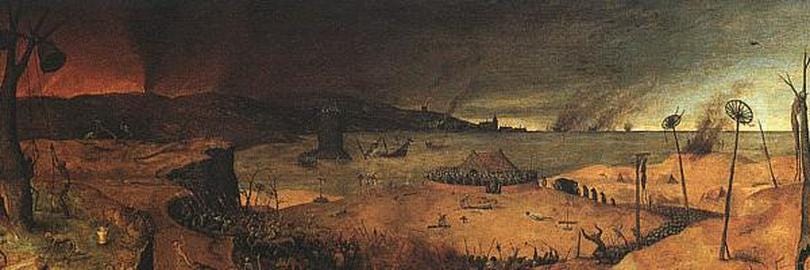
(The book links below lead to our Library, where they become affiliate links; if you buy through them, we earn a small commission at no extra cost to you, and the purchase supports the work. Thank you.)
You can feel it before you can name it. A thinning. The sense that the meaning has gone out of things, that institutions are hollow where they used to be load-bearing, that the words everyone says in public have come loose from whatever they once meant. You reach for the old sources of meaning and your hand closes on air. People call this a lot of things: burnout, anomie, the vibe shift, late-stage whatever. Most of the names are too small.
The Buddha named it too: dukkha, the first of his Four Noble Truths, a word we often flatten into “suffering” though it sits closer to a wheel off its axle, a subtle, pervasive out-of-jointness. This phenomenon has an older name, and it is precise. We are living in the Wasteland. I do not mean that abstractly, or as a metaphor I am reaching for. I mean it as a diagnosis, one with a literature that runs back through the modern poets to the medieval Grail romances to a layer of ritual older than writing. Our condition has a shape. It has a cause. And, against every appearance, it has a cure. This essay is the ground the rest of my writing stands on.
The Country We Live In
Start with the symptoms, because they stop being subtle the moment you quit looking away. A century ago the sociologist Max Weber, whose The Protestant Ethic and the Spirit of Capitalism is the classic study, named it the disenchantment of the world: the slow draining of the sacred out of ordinary life, until what remains is a mechanism to be measured and managed and nothing that asks to be revered. He thought the process was most of the way finished in his own day. He had not seen us. A newer name for the same decay, narrower and sharp, is enshittification: Cory Doctorow’s term for the way digital platforms rot from useful to extractive once they have you captured, anatomized in his Enshittification: Why Everything Suddenly Got Worse and What to Do About It. The pattern is older than the platforms: Jacques Ellul called the underlying force la technique, the drive toward efficiency that, once loosed, becomes autonomous and bends every human value to its own, and gave it a book, The Technological Society. Enshittification is what la technique does once it has you.
Evaluate the instruments. One of the fastest-growing categories in the Western world’s spiritual life is no religion at all, the Nones, tens of millions who walked out of their inherited faiths and found nothing built to stand in its place. Ryan Burge’s The Nones charts the exodus in data. I would be defined as one, so I understand. Films are sequels of sequels and reboots of reboots, the old myths strip-mined as product by corporations who cannot love them. Music is increasingly engineered to test well and be forgotten so the next hit can drop and replace it in a vicious cycle. The town square became a handheld feed optimized to keep you agitated and engaged, which is the opposite of nourished. None of these is the disease. They are readings on the instruments, and the instruments all point the same direction. The ground has gone dry, and in more and more places it has been paved over entirely. I mean that more literally than it sounds: we have sealed our soil, our institutions, and our common life under the same hard grey concrete, until nothing can take root and nothing can drink.
The Wound and the Land
Long ago, this condition was mapped in the language of myth. No diagnosis since has bettered that map. At the center of the medieval Grail romances stands the Fisher King, a wounded sovereign whose injury will not heal. The wound is usually to the groin, the seat of generation, and that matters because the king and his country are a single body. As he is sterile, so is the land. The fields will not bear, the herds will not breed, the waters fail. That is the Wasteland in its original frame: a kingdom gone barren because something at its heart is wounded and unspoken.
Joseph Campbell, who gave much of a life to this story and gathered it in Romance of the Grail, read the wound more sharply still: the Waste Land is the country of the inauthentic life, the king and his people living by inherited rule instead of inner truth, doing what they were told to want until the water failed. The land is barren because the life lived on it is borrowed. Which already shows the shape of the cure, not a better rule but a person willing to live from the inside.
If that sounds like solemn myth, it also runs as farce. The 2006 movie Idiocracy, directed by Mike Judge, who has spent a career satirizing exactly this, is the same diagnosis played for laughs: a civilization that has forgotten what water is, irrigating its dying crops with a sports drink because the screen recommends it, “Brawndo — It’s got what plants crave,” while the fields turn to dust. The Fisher King’s wound and the Brawndo fields are the same picture. The land goes barren the moment we lose the thread of it’s purpose.
Anthropology has its own picture of the rite gone hollow. After the Second World War, peoples across Melanesia who had watched cargo descend onto military airstrips built their own from bamboo and palm, lit runway fires, carved headphones from wood, and waited for the planes, having kept every gesture of the ritual and lost the one thing that made it work. We named them cargo cults, and we are one: we keep raising the airstrips, the reboots and the rebrands and the hollow institutions, and the cargo (meaning) does not land, because we retained the form and have forgotten the why. You can watch it in real time: the latest Shrek film arrived to a chorus saying the studio had kept the ogre and lost whatever once made him Shrek.
Older still, beneath the Christian varnish, the same story runs as ritual. The scholar Jessie Weston, whose From Ritual to Romance, published in 1920, sent T. S. Eliot to the Grail in the first place, traced the legend down to the vegetation rites that James Frazer collected in The Golden Bough: the god who dies as the year dies, the king who must be renewed or replaced so the crops will come, the whole drama of fertility and death staged so the world keeps turning. The Wasteland is what is left when that renewal fails. When the rite is forgotten, the water does not return on its own.
And in 1922 the war-shocked poet gave the condition its modern scripture. Eliot called his poem The Waste Land, and it reads like a transmission from within the thing. Eliot built it, by his own admission, on Weston’s Grail material: the speaker sits “upon the shore / Fishing, with the arid plain behind me,” the Fisher King relocated to a hollowed modern London whose crowds pour over London Bridge, “so many, / I had not thought death had undone so many.” Its landscape is the literal image of this essay, “Here is no water but only rock,” dry sterile thunder without rain.
It is a heap of broken images, voices and shards of every dead tradition jammed together and no longer adding up to a world, “These fragments I have shored against my ruins.” And it does not only wallow; it ends reaching for the cure, the thunder speaking its commands and the poem closing on “Shantih shantih shantih,” the peace that passeth understanding. He was not describing a private mood. He was describing the twentieth century, and ours has only grown drier.
Who Is Responsible
Here I have a decision to make, because there are two ways to explain a desecrated world and most reach for the easy one. The first says it was done intentionally. Someone is deliberately tearing down our symbols, hollowing our myths, profaning what we hold sacred, and if we could only name them we could stop them. This is the conspiratorial read, and its appeal is plain: it hands the wound a villain, and a villain can be fought. I do not believe it. Not because no one ever acts in bad faith, but because the simple explanation flatters human competence far past what the evidence allows. Nobody is running this. The hunger to find someone who is has a name. René Girard called it the scapegoat mechanism, the way a community discharges a diffuse crisis onto a single chosen victim, blames the wound on a person who can be cast out, and feels briefly clean again. The conspiratorial read is scapegoating in want of a target. The figure is older than the theory: the original scapegoat is the goat of Leviticus, laden on the Day of Atonement with the sins of the people and driven into the wilderness to carry them off, the ritual that Girard says merely made visible a thing we do without ceremony. Girard’s word for that victim, in the French of The Scapegoat, is the bouc émissaire, the emissary goat.
The truer answer is stranger and harder to fight, and the psychiatrist Iain McGilchrist provides its modern form. We all have two ways of attending to the world, housed loosely in the two hemispheres of our brains. One grasps the living whole, the metaphor, the sacred, the thing in its irreducible presence. The other manipulates, categorizes, breaks into parts, and pins each part to a label. McGilchrist labels them Master and Emissary, after a parable he found in Nietzsche and took for his title: a wise Master sends his Emissary out to administer the kingdom, and the Emissary, mistaking his own cleverness for the whole of wisdom, usurps the throne. A civilization run by the Emissary is precisely a Wasteland. It is a world of tokens with the presence drained out, a world that can measure everything and revere nothing, because to the Emissary there is nothing there to revere. We keep a flatter, everyday word for this world: secular. The philosopher Charles Taylor, in A Secular Age, frames the shift not as the simple loss of belief but as the move from a world in which reverence was the default to one in which it is one option among many, easy to doubt and easy to skip. That is the Emissary’s kingdom with the lights left on. Our symbols are not being murdered. They are starving, in a climate that no longer knows how to renew them, tended by the part of us that cannot taste what it is killing.
Here is the inconvenient corollary, the one nobody at either end of our politics wants to hold. Our Western hard separation of church and state, which we, ironically, revere as a sacred and a safeguard, is itself an Emissary move: the formal partition of the wholeness every human requires, sacred life and civic life cut cleanly apart, with the sacred half quietly starved of public air. Whatever it solved, and it solved real things, it also trained a civilization to keep its meaning in one box and its power in another, and to call the wall between them modern civilization itself.
The Wasteland has a newer name, and it has caught on fast among serious people trying to think clearly about our moment. They call it the metacrisis: not any one of our emergencies but the thing underneath them, the common generator that keeps producing climate and AI and institutional collapse and the epidemic of meaninglessness all at once. Daniel Schmachtenberger frames it as the generator function behind existential risk; John Vervaeke calls his version the meaning crisis; Jonathan Rowson and the circle around Perspectiva; Zak Stein and his time between worlds, are mapping the same terrain. It is all good work, and is mostly downstream of McGilchrist, which is the tell. Strip the contemporary vocabulary and the metacrisis is the Emissary’s world described from the inside, the newest intellectual name for the oldest condition. The Grail poets and the systems theorists are pointing at one wound from opposite ends of history.
All frames are wrong; some are more useful than others, and the metacrisis is among the more useful, because it takes the wound seriously and refuses to shrink it. Where I part from it is not to call it wrong but to call it incomplete. The metacrisis names the outer crisis, the broken sensemaking and broken coordination, the instruments by which we know and choose together, and the solutions it reaches for are exoteric: governance, institutions, technology, the repair of the systems themselves. That work is real and necessary. But it is the external half of a single wound whose inner half it cannot reach, because the generator beneath the generator is individual disenchantment itself: the metacrisis is the meaning crisis, and the meaning crisis is the Wasteland by another name. The esoteric solution, the inner one, is the work Aqua Regia Scriptura takes up, and it runs in a different mode entirely. To treat the whole thing as a systems problem with leverage points is already an Emissary move, the wound measured in the very voice that opened it. You cannot rationalize your way back to the sacred.
We are trained, in the Emissary’s world, to reach for “or”, to make the crisis of systems and the crisis of soul compete for the truth. The answer is “and”. John Lennon got there in a single word in “Mind Games”: the yes that is surrender rather than defeat. The outer repair and the inner one are the two halves of one cure, and the half this culture has forgotten how to perform is the one that begins inside a single person.
Garbage In, Garbage Out
The Emissary is not an enemy you can march out and meet in the field; it is the air you have been breathing your entire life. So the first move is not heroic. It is hygienic. There is an old principle from the dawn of computing: garbage in, garbage out. What you feed a system is what it becomes, and you are a deeply complex system. Most of us spend our days drinking from the exact wells that keep the land dry, the feed built to enrage, the news cycle built to frighten and never to resolve, the scroll engineered so the next thing arrives before the last thing can mean anything. You cannot re-enchant a world in the evening while pouring its disenchantment into your eyes for hours a day. So the negation comes first, and it is practical. Some of it you can cut today at no cost: stop watching the news, especially cable news, starting today, and notice the effect on your resting heart rate. Social platforms are harder, since you cannot walk away from all of them on day one, so the first move is to use them less with the standing intent of leaving the ones you can. Mute the commercials, pay for the ad-free tier, skip the ad wherever the option exists.
You now must buy your way out of being harvested, which tells you exactly what the free version was doing to you. This bargain is rarely spelled out, so I’ll say it plainly: most free consumer platforms are not gifts but harvesting operations, and the harvest is you. If you are not paying for the product, you are the product, your attention and behavior the raw material sold on. Shoshana Zuboff named the model surveillance capitalism, and her The Age of Surveillance Capitalism is its anatomy. Paying for the ad-free tier is buying back a sliver of what was already being taken.
Treat “the news” as the manufactured anxiety it largely is. I tell my wife that everyone on that glowing box on the wall is an actor, and I am not being metaphorical. The anchor is now a cast role, agented and stereotyped and coached to perform concern; the broadcast is a product engineered for arousal, not a window onto the world. And the performance runs deeper than the desk. Behind the anchor sits an editorial hand deciding what counts as true before it airs, the way a network can install new leadership and remake, almost overnight, what its own journalists are permitted to say. Subtler still is the framing, the quiet choice of which verbs carry blame and whose deaths get named, so that a broadcast can be scrupulously accurate and still decide for you who the victim was. And the choice among outlets is thinner than it looks: the newspaper, the local station you trust because it is local, and the cable channel often trace back to the same club of owners, so checking one against another is mostly theater, and a single script can be read word for word by dozens of anchors who appear to be independent.
It is the illusion of choice, the same trick we use to placate children, run at scale on adults who are fast asleep. Reality shows are no more real than the newscast; lawsuits and discovery have laid bare how thoroughly they are scripted, edited, and re-shot, the “unscripted” confessions stitched together from words the cast never said in that order. It is performers most of the way down. And the performance has escaped the screen. The same machine that made the anchor a role now manufactures idols at scale: the celebrity and the guru, the political savior, the sports team you call “us” — the jersey you pull on, the “we won” you say of a game you only watched — though you never took the field, the cult of personality and the influencer economy, parasocial bonds engineered so you feel intimate with someone who does not even know you exist. It is the disenchanted age reaching for a substitute religion, a counterfeit of the real relationships, the people actually in the room, that it hollowed out. And the invitation is always to become one yourself, to turn your own life into content, which is the harvest wearing a friendly face. Carried to its end it has a name, OnlyFans, where the commodification of the self reaches the body and even intimacy becomes the product on offer. None of this is retreat. It requires closing the intake valve on the sludge, so that something clean has room to come in and replace it.
Re-Sacralizing the Wasteland
Then comes the harder and better part, the work one no one can do for you. If the Wasteland will not arrive pre-sacred, you must make it sacred by the quality of attention you bring to it. This is not soft and it is not a figure of speech. Conscious attention is among the rarest and special things you possess, and where you direct it is an act of worship, whether you intend it as one or not. And it is being stolen from you. Gloria Mark, who has measured this for two decades at the University of California, Irvine, found the average stretch of attention on a screen fell from about 150 seconds in 2004, to 75 seconds by 2012, to roughly 47 seconds today, a figure five independent studies confirm; her book Attention Span documents the slide. This is the faculty the Wasteland erodes first, and every one of us has to win it back. Re-sacralizing the world means putting your attention back on things that can hold it: the meal made slowly, the book read slowly, the walk with no destination, the people actually in the room, the craft practiced well past the point of usefulness. Whole traditions are built from nothing else. The Japanese tea ceremony takes the simplest act, the making and drinking of a bowl of tea, and slows it into a rite of total attention, every gesture practiced until presence itself becomes the point; Okakura’s The Book of Tea is its small classic. You are not meant to copy it. You are meant to see what it is doing and go find, or build, rituals that are yours.
The internet already turned this idea into a meme: “touch grass,” it tells whoever has vanished too far into the feed. It is the bumper sticker the Emissary came up with for the cure, the right prescription spat out as an insult, because labelling the thing is all the Emissary can do. So go find and touch the grass, metaphorically. That means rebuilding small rituals where the culture has dissolved the large ones and treating the local and the real as more than raw material for content.
And read: deep reading is one of the most concentrated forms of the cure a person can practice. The slow disappearance into a long book is the rare ordinary act that puts the whole brain to work at once: the Emissary decoding the marks on the page in the service of the Master, who builds a living world out of them. It is the “and.” The scroll trains the opposite, a twitching, fragment-grabbing attention that never integrates; Maryanne Wolf, who studies the reading brain, shows in Reader, Come Home how the deep-reading circuit is built by use and worn away by skimming. Reading long things slowly is not improving a hobby. It is repairing the organ the Wasteland attacks first.
The Wasteland is not healed by policy or at scale. It is healed soil by soil, attention by attention, one person deciding the world in front of them is worthy of reverence and then living as though that were true. Do it long enough and it stops being a decision. Karen Armstrong, the former nun turned historian of religion, has spent a career on this exact point. Her A History of God traced the idea across the monotheisms, and in Sacred Nature she argues that a world which disenchanted itself can deliberately re-sacralize itself again, and across her larger work she keeps insisting that religion was never first a set of beliefs to affirm but a set of practices to perform and transcend: you do the ritual in order to learn and know the thing, not the other way around. That is the whole move. Reverence is not a feeling you wait to be given. It is a practice you take up, and the feeling follows the practice.
Reverence has a trap, and the traditions that go deepest name it. The sacred symbol must stay what Joseph Campbell called transparent to transcendence, a window you look through to the mystery you cannot touch, and never an idol you stop at and clutch; the instant you grasp it goes opaque, which is the Emissary’s literalism creeping back in. The Buddha drew the same line and called the path between them the Middle Way, neither clinging to the world nor fleeing it. So re-enchantment is not re-attachment. You hold the sacred and hold it loosely at once, reverent and open-handed, which is the one grip that does not strangle the thing it loves.
And the work turns inward as surely as outward, because the Fisher King and his country are one body. To re-sacralize the world is also to re-sacralize the self: to stop waiting for rescue and become the hero yourself, in the old pattern Joseph Campbell spent his life retracing in The Hero with a Thousand Faces. He found a single story under the world’s myths, the monomyth: the hero leaves the ordinary world, goes down into the wound, and returns transformed, carrying something the people who stayed behind still need. He read it through Carl Jung’s archetypes and the collective unconscious, through Freud and the work of dreams, and the journey is a map of inner change, not merely adventure. Which means it is addressed directly to you. You are the hero of your own story, the one who goes down into the wound and comes back able to ask the question.
This is more than a literary pattern. A whole tradition, with Ernest Becker’s The Denial of Death its classic statement and the psychiatrist Irvin Yalom close behind, argues that becoming the hero of a story larger than yourself is how a person bears the oldest problem in the human condition, by pouring the self into something that will outlast it. You do not have to prove which answer is true; you have to find one that is life-giving and commit to it the way Kierkegaard’s knight of faith does, living as if it matters even without certainty. Academy of Ideas has mapped this ground far better than a paragraph can, so if it pulls at you, start with their video How to Escape a Meaningless Life.
The Master and the Emissary, at war inside every one of us, are meant to be wed rather than to have one usurp the other. That wedding has an old name. The alchemists drew it as a king and queen joined into a single body and called it the coniunctio; an older tongue called it the hieros gamos, the sacred marriage; Jung read it as the fusion of our divided halves into one whole self, and gave it a book, Mysterium Coniunctionis. That marriage is the real labor, and it is the subject of a later book of ours. Here it is enough to say that the land is healed soil by soil and also self by self, and that the self is the first soil, not the last.
The Question
None of this begins with an answer. This is the part the old story knew and we forgot. We circle back now to the same Grail romance we began with, the Fisher King and his barren land, because the myth that diagnosed the Wasteland is the one that holds its cure. In Wolfram von Eschenbach‘s telling, the young knight Parzival reaches the Grail castle, sees the wounded king and the bleeding lance and the Grail itself carried past him, and says nothing. He had been coached, by a well-meaning mentor, that a knight does not ask too many questions. So he holds his tongue, rejects the plain human curiosity rising in him, and by morning the castle is empty and the moment is gone. The land stays barren for years for want of a single question. When he finally finds his way back and asks it, the question that heals the Fisher King and restores the Wasteland is not clever. It is curious, and it is kind. Whom does the Grail serve? What ails thee? He had to care enough to want to know. The cure gets a modern retelling in The Fisher King: Robin Williams as a broken man on a Grail quest through New York, and a burned-out radio shock-jock, a creature of the media machine, who is redeemed not by force but by a single act of care.
That is the cure, and it is at once smaller and larger than most people expect. The Wasteland does not end in certainty. It ends with a question asked from real curiosity, which is the one move the Emissary cannot make, because the Emissary is forever certain it already knows what everything is. Curiosity is the crack in the concrete where the water gets back in. It comes before meaning, before re-enchantment, before any of the rest; it is the precondition for all of it. Which is why the first book I am writing is about exactly this, and why it carries the title it does: Love Isn’t All You Need: A Manifesto for Curiosity. The Wasteland is the territory. Curiosity is the path. Ask the question, then keep asking, and the water returns.
So when I write about a new movie, or a show that animates action figures into comedy, or a blockbuster daring you to want the aliens disclosed, or a celebrated director’s remake of Homer, or a children’s rhyme followed all the way down into the nature of reality, or anything else that looks too small to bear any weight, this is what is running underneath it: a search for the live water still moving in the rubble, and a report of where I have found it. These essays are dispatches from the Wasteland. This one is a map. The maps you were handed were incomplete; this is the start of a better one.
If any of this resonates with you, take it as the surface of something much larger. Behind these dispatches lies a deeper and more systematic body of work, a whole library that maps this territory corner by corner, for the reader who finds the map is not enough and wants to walk the actual ground. That deeper work has a name, The Athanor, and it is being built now. Subscribe to this Substack and you will hear the moment it opens.