
Calibrating the Lens
Every essay is written from somewhere. This is where I write from, so you can calibrate your lens before you trust the picture.

(Book links below lead to our Library, where they become affiliate links; if you buy through them, we earn a small commission at no extra cost to you, and your purchase supports our work. Thank you.)
First, who is writing. These essays come out of Aqua Regia Scriptura, a small independent esoteric press, and I am Ryan Maple, the author who writes them. Aqua Regia is not a one-man operation; it is a partnership with my wife, Christi. I write the maps — the manuscripts, the architecture, the long descents — and she runs everything that faces outward, the community and the public side of our work. So, when I write all of this as a man, from a man’s vantage, know that there is a beautiful woman across the table who reads everything before you do and tells me where it rings true and where it does not. For whatever it is worth, she confirms the anima and the animus from her side of our marriage.
Everything I publish comes through a particular person standing in a particular place. That is not a flaw to apologize for; it is the only way anyone has ever written anything. The honest move is to name the place out loud — and by the end of this essay you’ll be able to tell my frame from the thing it points at. The frame is mine. What I am pointing at is yours, or it is no one’s. Take what survives translation into your own life, and leave the rest.
Apophenia
One caveat, in good faith, which I will state once here rather than repeat in every essay. My readings find patterns, and there is a precise word for finding patterns where no one planted them: apophenia, the mind’s knack for seeing meaningful shapes in noise, faces in clouds, a sacred syllable in a pop song. I am rarely claiming the artist sat down and consciously encoded what I find; when I read the Mandukya Upanishad out of a Harrison song, or the coniunctio out of a metal album, I am not saying they meant it. Take these as thought exercises, as they are offered in that spirit. My point is not that meaning was intended; it is that meaning is there to be found, and that dis-covered meaning still counts, provided you hold it as a reading and not a fact. For a demonstration you can wait for the end, where a phrase someone copied off a gas-station greeting card became a number-one record carrying a verse of the Gospel of Thomas, with no one in the chain intending any of it: meaning found, meaning never meant intentionally, yet real all the same. Meaning may be found. It must also be contextualized.
My Vessel
I am a man, am straight, have been married for 20 years, and have known Christi for nearly a decade longer. When I write about the murdered feminine, inner woman, or the sacred marriage, I am writing from inside a male body that spent its boyhood learning to bury the very thing I now write about recovering. That is not incidental to the work; for me it is the work. You do not live in my body, the particulars will not map 1:1, and the operation underneath is not male and was never meant to be. Jung built that into the anima and the animus; Campbell into a monomyth he found wearing every culture’s face. The pronouns are mine. The picture is yours.
My Life
I am childfree, and I am of sound mind, by which I mean I am not, at present, in anyone’s professional care. I name that not to wave off the depth these essays sit in, but because you should know the descents I describe were made from stable ground, not transmitted live from crisis. If you are standing somewhere less steady, you will know better than I will whether this is your moment to follow me down.
My Inheritance
I am American, cut from a Western worldview, and I will not pretend to stand nowhere. I was raised Catholic —rites, rituals, the whole architecture — and I walked away. On a good day, I like to think I transcended it: kept what was true, set down what was inherited. I have spent the years since as what the sociologist Ryan Burge, in his book The Nones, would file under “None”: unaffiliated, but not uninterested. So when I read scripture as one myth among many, or hold Isis and Tiamat and the Gospels in the same hand, know that I am not a tourist who never believed; I am someone who believed, left, and circled back from outside. That circling-back has a lineage — it is the perennialist’s wager Aldous Huxley set down in The Perennial Philosophy, that one thread runs under all the traditions — and it is the ground I write from here. Joseph Campbell mapped the same unity from the other side, calling it the Hero’s Journey, the one Monomyth he found wearing every culture’s face and set out in The Hero with a Thousand Faces; the perennialist and the mythologist are pointing at a single story.
Reading
I am college educated and spent more than 25 years in information security, which is a field that punishes magical thinking and where being wrong is not a vibe but a breach. I left because I could not find meaning there, and I want to spend the back half of my life on something that is meaningful. Part of what pushed me was Manly P. Hall — whose The Secret Teachings of All Ages is one of the great compendia of the Western esoteric tradition — and one lecture of his, on your second half of life: that the years past your working career are not a winding down but the real work, and that, as he put it, as we step out of the old dimension of jobs we must step into a new dimension of insight. I was also, in college, a few credits shy of a philosophy minor, which is to say close enough to formal training to respect it, and far enough outside to owe it nothing. Through Hall’s lens, those unfinished credits were not a failed credential but point zero: the subdominant interest, planted early, that gestated beneath the hacker persona and is only now becoming dominant. Philosophy, near the turn of the century, was the seed. Information security was the cover it grew under.
Our cognitive maps are built from what we read, and mine is built from reading wide, eclectic, and frankly occult materials. That carries a cost I will not hide: to truly follow my points, you will have to do the work yourself, go to primary sources rather than summaries, which is what The Library is for. For anyone committed to this work, reading is not a burden; it is the whole pleasure. And it is where this work gets out ahead of Campbell and Jung and the rest, not by being smarter than them but by reading across all of them at once, refusing to stop where any single one of them stopped, and using resources they never had. Resources I lean on simply did not exist in their lifetimes; that is the quiet gift of standing on their shoulders. So, I will say the unfashionable part plainly: I use GenAI to help me formulate and organize this complex material. The vision and wager are mine. Arranging a library’s worth of material is not work I do alone, and refusing a tool that can lay the whole shelf out at once would be throwing the baby out with the bathwater.
The Work
I am in the second half of my life, at work on my own Magnum Opus, and everything here is its public edge. The slow work itself happens in Athanor — the furnace, in the old alchemical sense — and in The Manifesto Series books I author. If anything in this essay matters more than the rest, it is this: I am not a scholar, and I am not your teacher. I hold no credentials, am handing you no method and no instructions, and I am, by honest admission, a jack of all trades and master of none. I am a man reporting what worked for him, what held when other things did not. I prescribe nothing; I describe. What you do with my descriptions is up to you.
Everything I write is sourced. I cite where I dis-covered it and point you to the originals, because I would rather you check me and read the source yourself than take my word for any of it. The frames I build out of those sources are a different kind of thing. All frames are wrong, in the sense that no map is ever the territory, but some are useful, and the ones I hand you are tools to be picked up and put to work, not idols to be believed. Take a frame as far as it carries you, set it down when it stops, then find a better one.
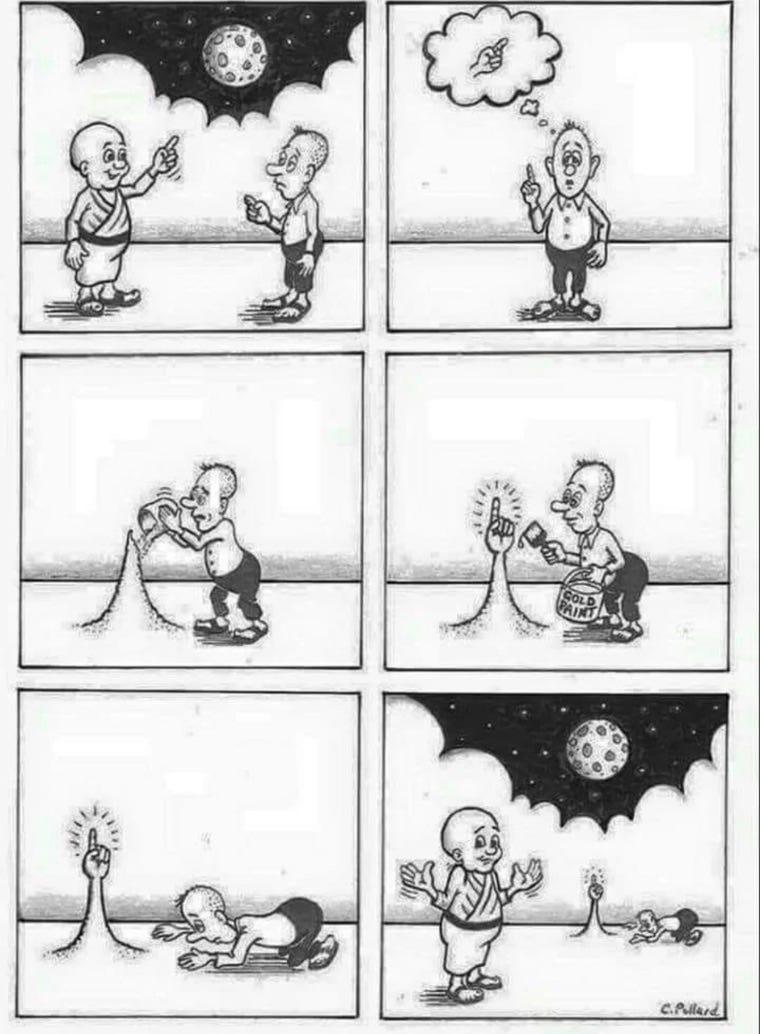
One final warning, because it is the failure mode I fear most. I am allergic to cults of personality, my own included. There is an old image for exactly what I am asking: a teacher points at the moon, and the student, instead of looking where the finger points, falls in love with the finger, studies it, gilds it, builds a shrine to it, and never once turns to see the moon that hung there the whole time. Do not do that with me. I am the finger. The moon is yours. The moment you find yourself more interested in the pointer than in what it points at, you have wandered into the exact cult dynamic I take dissect in the Cults and Culture chapter of Love Isn’t All You Need. Look at the moon, not my finger.
The Turn
Everything above is about me. This last part is about you, or, rather, about what reading my work will ask of you, which is the deepest assumption of them all. My essays do not move along a straight line; they turn a corner — and over time, a spiral staircase, the same ground seen one turn higher each time. They ask you to do something with your mind that curiosity alone will not accomplish, and the honest move is to show you the thing once, in the open, on a single word, so you know what you are agreeing to. The word is eternity.
Ask most people what eternity is and they extend a line: more time, time without end, the clock running forever. That picture is not wrong by accident; it is an inheritance with a paper trail. The eternity we were handed is chronos, the time of sequence and schedule and the calendar, and our calendar is a relic of empire: the spring new year of Marduk carried through Babylonian exile into the Hebrew year, inherited by Rome, hinged onto Janus at a January first that marks nothing but the day the consuls took office, frozen by the Gregorian reform, and spread by the Church that inherited Rome until the whole earth counts time from a bureaucrat’s convenience. That is the eternity of endless duration, chronos with no edge, the open line that never closes. But the same machine buried a second time, kairos, the time of the right moment, the opening that arrives when it arrives, the Goddess’s time the clock had no room for. The eternity mystics were pointing at lives there. Not more time. Timeless. The eternal Now that Eckhart Tolle named in The Power of Now. The full genealogy of how the West mislaid this is the spine of my future work on the perennial esoteric philosophy.
You cannot reach a second eternity by walking farther along the first. That is the trap, and it has a name in mathematics and in the study of dreams alike: infinite regression, the line you extend forever and never finish, because the end of the line was never going to be found on the line. The move is perpendicular. Step up a dimension and the whole picture reorganizes. A flat, two-dimensional creature cannot imagine “up,” and watches a sphere pass through their world as a circle that appears, swells, shrinks, and vanishes, experiencing cross sections as a sequence in time what is in fact a single solid it meets one slice at a time. That thought experiment is not mine. A Victorian schoolmaster named Edwin Abbott drew it in 1884 and called the two-dimensional world Flatland; his flat creatures meet a sphere exactly this way, as a circle that comes from nowhere, swells, shrinks, and is gone. Physics keeps meeting the same open line from its own cult, where infinity in its equations is not a thing that exists, but a quiet confession that a theory has reached its edge: the singularity where general relativity breaks down inside a black hole and at the universe’s first instant, the runaway sums quantum field theory has to renormalize away. Infinity is the map’s boundary written in mathematics, the placeholder for what the model cannot yet close.
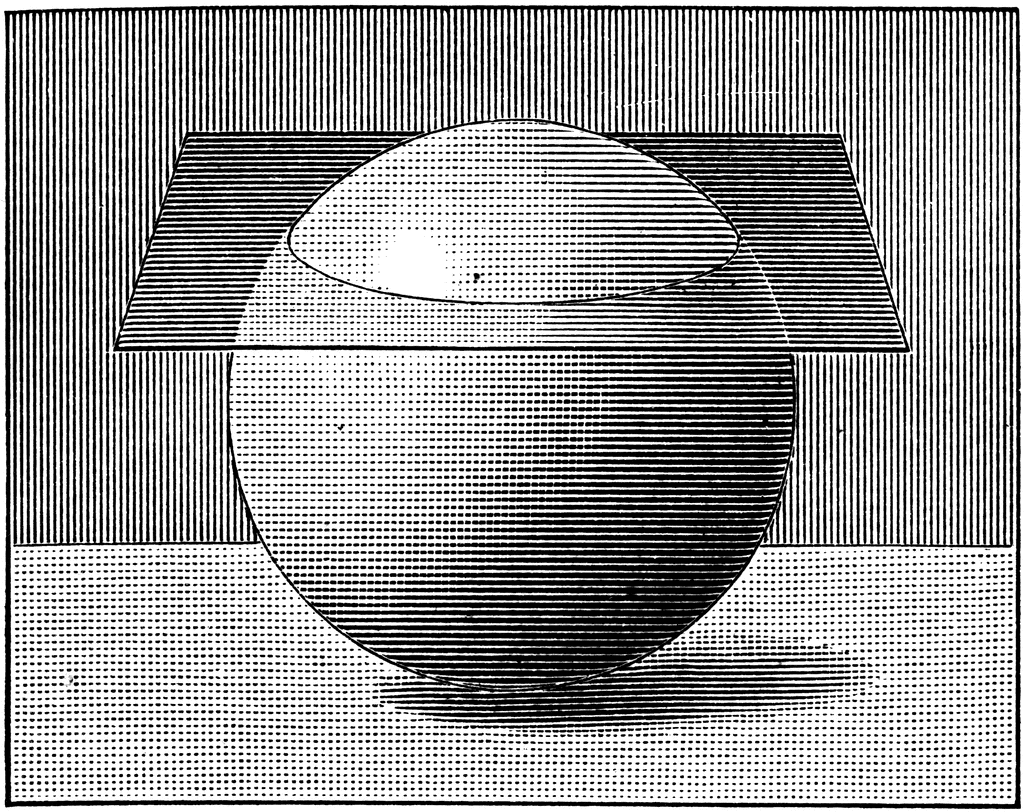
This is the holographic principle, the whole enfolded in every part, a thread I follow much further in future essays. We are those Flatland creatures, and our river of time is that sequence: the moving shadow of a timeless whole we can only light one cross-section at a time. Eternity is the whole shape seen at once, from one dimension up. And when you make that move, geometry closes on itself. Nicholas of Cusa wrote in 1440 that in an infinite circle the circumference becomes a straight line; alchemists drew the same truth as the Ouroboros, the serpent whose mouth has reached its tail, inscribed hen to pan, one, the all; modern mathematics calls it the point at infinity, where the number line closed into a ring reveals that its two runaway ends were one point the whole time. Einstein said the same: a satellite in orbit is in free fall, traveling the straightest path it can through a spacetime that our mass has curved, going perfectly straight, and its straight path is, to us, a closed loop. The line is the circle. The opposites you thought were fleeing each other – start and end, positive infinity and negative infinity, yin and yang, this life and your previous, eternal-now and all-time – are one unified thing, seen from the higher dimension that holds them both. That is the marriage every mystery tradition points at, what Joseph Campbell called bridging the pair of opposites, and it is what I am asking you to do, once, here, with the word eternity.
This is where I owe you the honest limit of curiosity, which Love Isn’t All You Need otherwise treats as an important engine. Curiosity moves you along the line: more questions, more territory, more of the map you already hold. It is indispensable, because it is what carries you to the edge of that map and lets anomalies pile up until the flat picture visibly fails. But the turn itself is not more information. Thomas Kuhn, who gave us the phrase “paradigm shift,” was exact about it: the shift is a gestalt switch, the duck becoming the rabbit in the figure below, a conversion and not a summation. He made the case in The Structure of Scientific Revolutions.
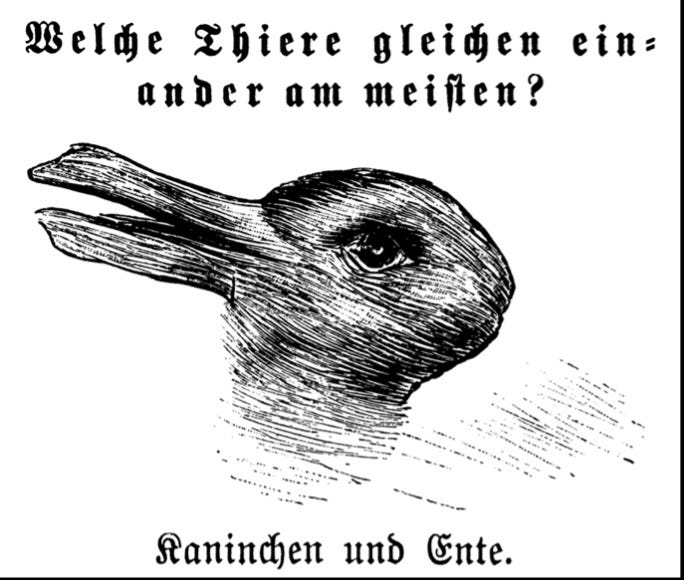
The same lines, two animals; nothing on the page changes, only which one you see.
This duck-rabbit is the switch holding still. If you want to watch it in motion, there is a small 1960 physics film available on YouTube called Frames of Reference in which two men each see the other hanging upside down until one of them shrugs and says, “you better come into my frame of reference.” From there it only deepens: the same falling ball traces a parabola from one seat and drops in a plain straight line from the next, and a force that is unmistakably real to the man on the spinning platform is no force at all to the observer standing on the ground beside it. Nothing about the ball or the force changes, only the frame you watch it from. It is the same turn you just made with the word eternity and the duck-rabbit, this time with a falling ball — proof the switch is not a trick of language but a fact about how perception works.
No amount of fact about a line ever adds up to up. In the language of the divided brain it is a circuit completing: the Emissary hands its work back to the Master, and the Master casts the symbol into the whole and looks through it like a window. A symbol becomes transparent to transcendence exactly when it has been carried all the way around that loop and brought home, not thrown away, which leaves only a formless feeling, and not clutched as literal fact, which freezes it into an idol, but kept as a window you look through to the sacred thing it points at. The open loop, the Emissary keeping its map and mistaking it for the world, is the line that never closes, the infinite regression; the closed loop is the Ouroboros. And there is a formula I lean on in my books for what completes the circuit: wisdom = knowledge + experience - fear. Curiosity supplies knowledge. The turn supplies experience. Fear, the refusal to let your old map be redrawn because stepping off the line feels like dying, is the term nobody names and the one that holds most people in place. Subtract your fear and your gestalt fires. That is why knowledge alone has never made anyone wise.
So how is fear subtracted and experience embraced, since by now it is clear that neither can be read off a page? Through the two doorways that loosen the daytime mind: dreams, which happen to you, and meditation, which you do with intent. Freud called dreams the royal road to the unconscious; Jung made dreams his working key to becoming whole; Dunne noticed that in sleep his grip of serial time slackened and a higher view leaked through. Meditation is that same loosening made deliberate, and on the far side of it you meet a witness, the part of you that watches your thoughts arrive without being your thoughts. One tradition mapped this with unusual precision, in their Mandukya Upanishad, folded their whole architecture into one syllable, AUM: A is waking, U is dreaming, M is deep sleep, and the silence the sounds dissolve into is Turiya, the fourth, the timeless witness beneath all three. AUM is the Ouroboros made audible, cycling through states then closing into silence, and chanting it, letting the sounds fall from A through U through M into the silence it dissolves in, is how the crossing is experienced rather than merely known. That silent witness wears many faces. The Vedantin calls it the sakshi; even our laboratories keep finding the conscious self witnessing an action the brain had already begun; and in my line of work she is the Silent Witness herself, Mary Magdalene at the tomb before dawn, the watcher from her tower, and beneath her Nephthys, keeper of the threshold between death and resurrection, she who holds the view while the ground is chaos. The witness is what you are when you stop being the line and become the dimension that watches it.
If you want to watch this happen to one person in public, listen to Belinda Carlisle. In 1987 she famously sang Heaven Is a Place on Earth, a number-one song she did not write in a bright, major-key, heard by tens of millions as a sappy love song. Six words of the Gospel of Thomas rode in on a synth-pop hook, his kingdom spread upon the earth with no one seeing it. And it goes deeper than Carlisle even not writing it: the writers were not transmitting anything either. Ellen Shipley lifted the phrase off a greeting card at a Brooklyn gas station and Rick Nowels sharpened it in the studio, two pop professionals reaching for a hook, not scripture. Six words rode into our culture on a rack of disposable cards adjacent to motor oil, indifferent to every hand it passed through. That is what transmission looks like when nobody in the chain knows what they are carrying. Then, decades later and on the far side of her own turn toward contemplative practice, she re-recorded it slow and acoustic, as a hymn, on an album steeped in mantra. The lyrics did not change. Carlisle became transparent to them. Play the two versions in sequence and you can hear the gestalt switch cross a single human life: heaven as a place your songwriters told you about, then heaven as the place you are standing right now, observed one dimension up. And then, if you are willing, do the one thing this whole essay is for. Take your own word, heaven or eternity or God or soul, whatever loaded inheritance you were handed as a flat picture, and turn it. That is the move under everything I write. Eternity was just an example I used to illustrate my point.
Let’s turn one more word before you go, to keep the turn going. We inherit life as a finite game — the phrase is James Carse’s, from Finite and Infinite Games — played to win and to end, scored, bounded, over the moment someone takes the prize. Then turn it: an infinite game is played for the opposite reasons: to continue play, to keep the game in play, to be wholly in it with no final whistle and no final score. And notice that this infinite is not the same infinity of a few paragraphs ago, the open line that could not close; it is the kairos infinite, the Ouroboros, the play that has no outside. The same word, turned, points two opposite ways, which is the whole lesson. How you hold eternity decides which game you believe you are here to play.
The Frame Is Not the Picture
None of this is here to fence in my work or to ask your indulgence. It is here so you can understand me and my work accurately: as one specific person, in one specific place, in one specific time, pointing at something he believes is not specific at all. Hold my frames loosely. If they distract you, set them down. The pictures are for you.
These ideas are explored at length in Love Isn’t All You Need: A Manifesto for Curiosity, to be published later this year. Leave your email at loveisntallyouneed.com/notify and I’ll tell you the moment it’s released.